Your brain has.
That’s because human vision isn’t simply a camera recording everything in front of us.
Your eyes collect visual information, but your brain has to organize it.
Which lines belong together?
What is the object?
What is the background?
Where does one shape end and another begin?
What familiar thing does this pattern most closely resemble?
Your brain makes those decisions extraordinarily quickly, usually without you noticing.
Most of the time, that’s useful.
If you had to consciously analyze every edge, shadow, color, and shape before recognizing a coffee cup, another person’s face, or an approaching car, ordinary life would become impossible.
So the brain uses previous experience, expectations, context, attention, and incoming sensory information to construct the most plausible interpretation.
Ambiguous images exploit that system.
They give your brain a puzzle with more than one reasonable answer.
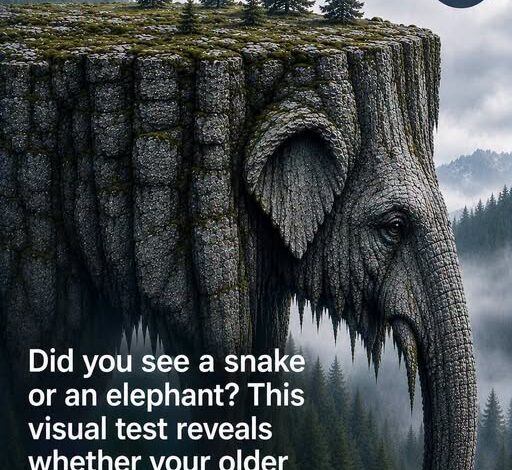
Your attention may initially settle on a particular contour that makes the snake immediately apparent.
Someone else’s eyes may land elsewhere, allowing the elephant to emerge first.
Once your brain commits to one interpretation, other elements of the picture get organized around it.
Then something shifts.
Maybe your eyes move.
Maybe somebody tells you another animal is hidden there.
Maybe you stare long enough for your original interpretation to weaken.
Suddenly, the same lines reorganize themselves.
And there it is.
The second image.
That perceptual switch has fascinated psychologists and neuroscientists because it demonstrates an important principle:
Seeing is an active process.
We don’t experience the external world as untouched raw information.
Our brains continuously interpret that information.
That doesn’t mean reality is imaginary.
It means perception requires processing.
The famous Rubin vase provides another example.
Depending on how you organize the image, you may see a vase in the center or two faces looking toward each other.
The Necker cube produces a similar effect. Its orientation seems to reverse even though the drawing remains completely unchanged.
These illusions allow researchers to investigate attention, visual awareness, figure-ground organization, and other aspects of perception.
But somewhere between the psychology laboratory and social media, something else happened.
Ambiguous images became personality tests.
“See this first? You’re a genius.”
“Notice this animal? You’re secretly afraid of commitment.”
“Only highly creative people spot the hidden figure.”
Those claims can be entertaining.
They shouldn’t automatically be mistaken for psychological science.
A meaningful personality assessment requires considerably more than attaching personality labels to whichever object someone happens to notice first.
Researchers would need evidence that the test reliably produces consistent results and that those results actually correspond with the personality characteristic being claimed.
Without that evidence, the interpretation is essentially a story attached to an optical illusion.
Seeing the snake first doesn’t prove you’re dangerous, suspicious, anxious, analytical, or unusually intelligent.
Seeing the elephant doesn’t establish that you’re loyal, compassionate, patient, or emotionally mature.
Sometimes you simply saw the snake first.
Recent Articles

You won’t be fooled again after seeing this
News If a Woman Has Small Breasts, Does It Really Mean Anything About Her Personality or Body? Experts Break Down Common Myths, Social Stereotypes, Biological Facts, and Misconceptions, Revealing Why Body Features Do Not Define Character, Confidence, Health, or Worth, Challenging Outdated Beliefs and Encouraging a More Realistic, Respectful Understanding of Natural Human Diversity and individual differences

Massive python with swollen belly found under family’s shed — X-ray reveals its last meal