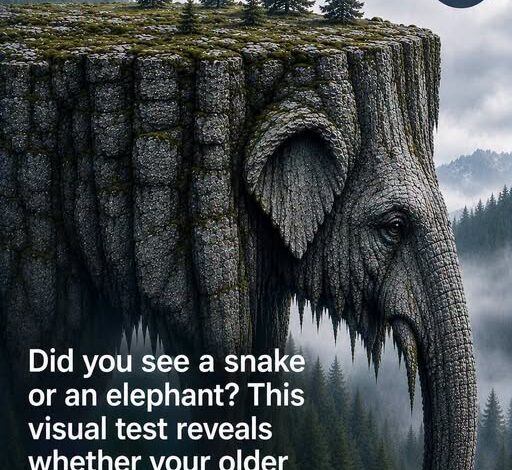
And that’s enough.
Because the genuine phenomenon is already remarkable.
Think about what happens when the image flips.
The physical picture hasn’t changed.
The light reaching your eyes may be virtually identical.
Yet your conscious experience becomes different.
Something that was almost invisible seconds earlier suddenly becomes impossible to miss.
That tells us far more about human perception than an arbitrary personality label ever could.
It also offers a small reminder about everyday life.
Attention matters.
Expectations matter.
Context matters.
Two people can receive the same visual information and initially organize it differently—not because one is necessarily smarter or better, but because perception is an active negotiation between sensory information and the brain interpreting it.
So the next time an online image asks:
“What did you see first?”
Go ahead and answer.
Snake.
Elephant.
Whatever appeared.
Just be skeptical when someone immediately claims that your answer reveals your deepest fears, your intelligence level, or the hidden architecture of your personality.
The illusion doesn’t need that mythology to be extraordinary.
The truly astonishing part is happening inside your head.
A few lines sit perfectly still on a screen.
Your brain examines them.
It builds an elephant.
Then, without the outside world changing at all, it tears that interpretation apart and builds a snake.
That’s not a secret personality test.
It’s a tiny demonstration of one of the most remarkable things the human brain does every waking second:
It doesn’t merely receive the world.
It interprets it.
Recent Articles

You won’t be fooled again after seeing this
News If a Woman Has Small Breasts, Does It Really Mean Anything About Her Personality or Body? Experts Break Down Common Myths, Social Stereotypes, Biological Facts, and Misconceptions, Revealing Why Body Features Do Not Define Character, Confidence, Health, or Worth, Challenging Outdated Beliefs and Encouraging a More Realistic, Respectful Understanding of Natural Human Diversity and individual differences

Massive python with swollen belly found under family’s shed — X-ray reveals its last meal