
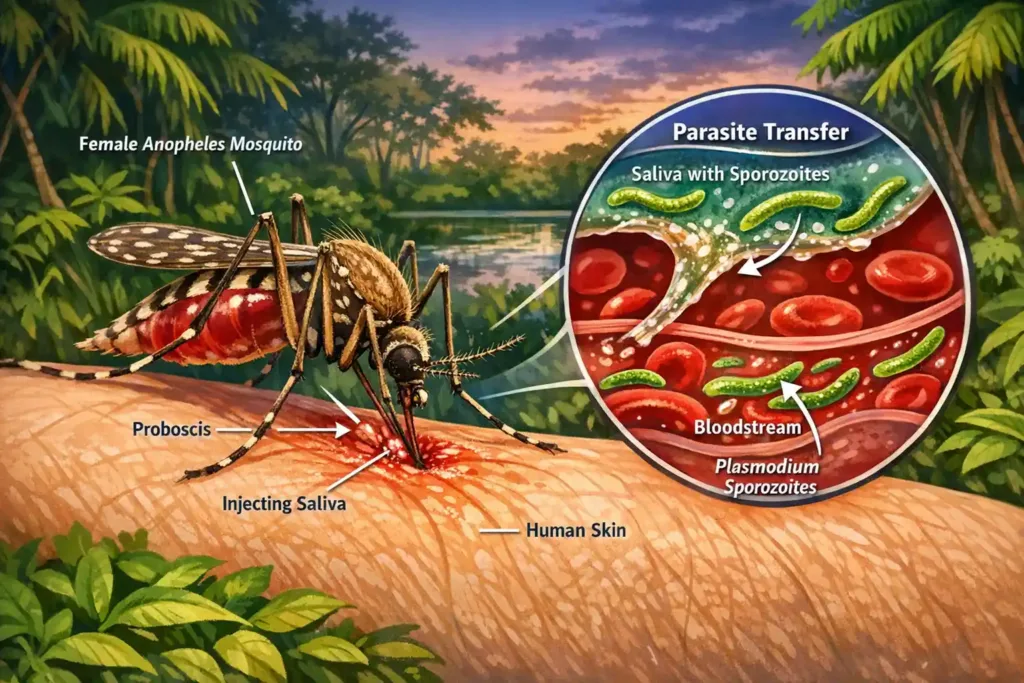
Other Supportive Tests
After malaria is confirmed, additional tests assess complications:
-
Complete Blood Count (CBC):
-
Hemoglobin: Checked to detect anemia.
-
Platelets: Usually low (thrombocytopenia).
-
WBC: Count is variable.
-
-
Liver Function Tests (LFT):
-
Bilirubin: May increase (indicating jaundice).
-
SGOT/SGPT: May be elevated, indicating liver involvement.
-
-
Renal Function Tests (RFT):
-
Creatinine and Urea: Checked to assess kidney function (crucial for renal failure in severe malaria).
-
-
Blood Glucose:
-
Checks for hypoglycemia, especially in children and pregnant women. Essential in severe malaria.
-
-
Arterial Blood Gas (ABG):
-
Checks for metabolic acidosis and oxygen saturation in severe cases.
-
-
Chest X-ray:
-
Rules out pulmonary edema if respiratory symptoms are present.
-
When to Test for Malaria
Definite Indications:
-
Anyone with a fever who is from or recently visited a malaria-endemic area.
-
Unexplained fever lasting more than 2-3 days.
-
Fever with typical symptoms (chills, rigors, sweating).
-
Presence of Splenomegaly or Anemia with fever.
High Risk Groups:
-
Pregnant women with fever (from endemic areas).
-
Children with unexplained fever and anemia.
-
Travelers returning from endemic areas with fever.
-
Blood donors (screening).
Diagnosis Strategy
The ideal approach is:
-
Clinical suspicion based on history and symptoms.
-
RDT for quick screening (resource-limited settings).
-
Microscopy for confirmation and species identification.
-
Assess severity by parasitemia count.
-
Other investigations for complications.
You May Also Like
Non-Pharmacological Management
Malaria treatment is not limited only to giving medicines. Non-pharmacological measures are equally important for prevention, supportive care, and recovery. These measures play a very important role in controlling the disease and preventing its spread.
Prevention Strategies
Prevention is always better than cure. There are several effective strategies to prevent malaria.
A. Vector Control Measures (Mosquito Control)
The most effective way to control malaria is to control the mosquito population and prevent mosquito bites.
Indoor Residual Spraying (IRS)
-
IRS is a very effective method in which insecticides are sprayed on the walls of the house. When a mosquito sits on the walls, it comes into contact with the insecticide and dies.
-
This spraying is usually done once every 6 months. This service is provided free of cost through government programs in endemic areas. Pyrethroid-based insecticides are commonly used.
-
Benefits: Long-lasting protection, community-level impact, and reduction in transmission.
Insecticide-Treated Bed Nets (ITNs)
-
ITNs are the most popular and cost-effective prevention method. These mosquito nets are treated with insecticide that kills or repels mosquitoes.
-
Long-Lasting Insecticidal Nets (LLINs) are now available, which remain effective for 3-5 years without re-treatment. These are especially important for pregnant women and children.
-
Proper use is necessary: Put up the net before sleeping at night, the net should not have holes, and the net should be properly tucked so that mosquitoes cannot enter.
Larval Control
Controlling mosquito breeding is also important. The Anopheles mosquito breeds in stagnant water. Measures include:
-
Removing stagnant water (water containers, tires, broken pots).
-
Using larvicides in ponds and ditches.
-
Biological control such as fish (Gambusia) that eat larvae.
-
Improving the water drainage system.
-
Communities should be educated to keep their surroundings clean and prevent water collection.
Environmental Management
Mosquito breeding can also be reduced by modifying the environment:
-
Maintaining a proper drainage system.
-
Trimming bushes and vegetation (mosquitoes should not find hiding places).
-
Proper garbage disposal.
-
Avoiding water accumulation at construction sites.
Recent Articles

You won’t be fooled again after seeing this
News If a Woman Has Small Breasts, Does It Really Mean Anything About Her Personality or Body? Experts Break Down Common Myths, Social Stereotypes, Biological Facts, and Misconceptions, Revealing Why Body Features Do Not Define Character, Confidence, Health, or Worth, Challenging Outdated Beliefs and Encouraging a More Realistic, Respectful Understanding of Natural Human Diversity and individual differences

Massive python with swollen belly found under family’s shed — X-ray reveals its last meal

THE FIRST ANIMAL YOU NOTICE MAY REVEAL SOMETHING SURPRISING ABOUT YOUR THINKING STYLE

