

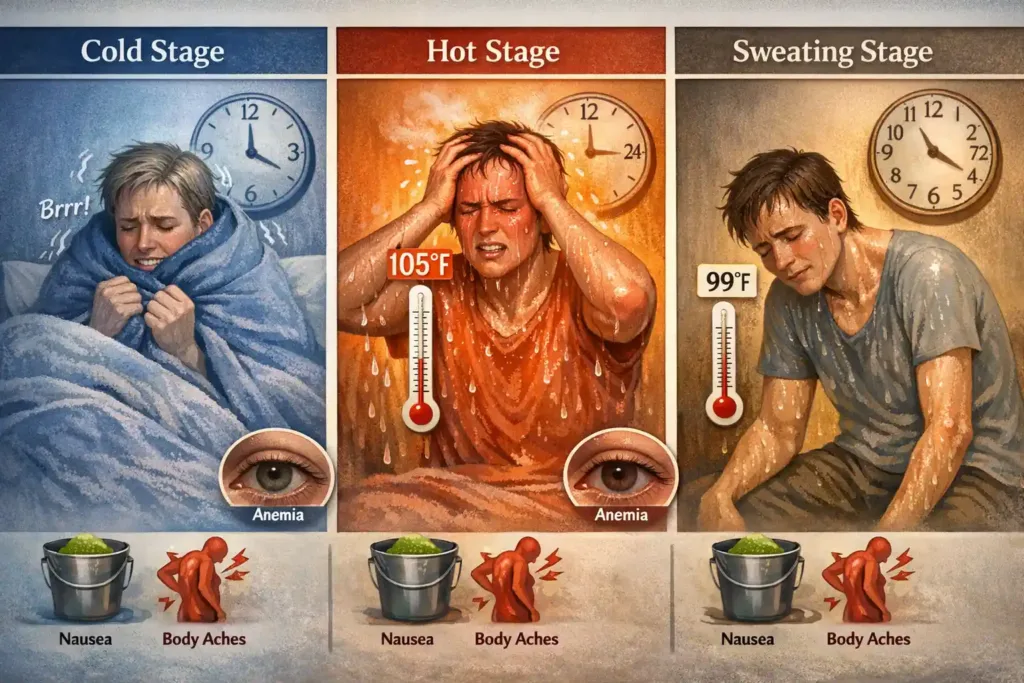
Physical Examination Findings
When the doctor examines the patient, some specific findings are observed:
Splenomegaly (Enlargement of the Spleen)
-
This is a classic finding of malaria.
-
The spleen becomes enlarged and can be felt in the left upper abdomen.
-
In chronic malaria, the spleen can be very large. Doctors check for this with palpation.
Hepatomegaly (Enlargement of the Liver)
-
The liver may also become enlarged, but this is less common than splenomegaly.
-
Tenderness may be present in the right upper abdomen.
Signs of Anemia
-
The patient’s skin and mucous membranes appear pale.
-
The conjunctiva (inside the eye) is pale, which indicates anemia.
-
The nails also become pale.
Jaundice
-
Some patients may develop jaundice. The eyes and skin look yellowish.
-
This occurs due to the destruction of red blood cells (RBCs).
Tachycardia
-
The heart rate increases, especially during fever.
-
The body attempts to compensate.
Dehydration
-
Due to vomiting, sweating, and poor oral intake, the patient becomes dehydrated.
-
Skin turgor decreases and mucous membranes become dry.
Complications
If malaria is not treated in time, especially P. falciparum malaria, then serious complications can develop:
Cerebral Malaria (Malaria of the Brain)
This is the most serious complication. The patient becomes confused and behaves abnormally. Seizures (fits) can occur, and in severe cases, a coma may happen. This is a medical emergency and requires immediate treatment.
-
Signs include: altered consciousness, seizures, neck stiffness, abnormal posturing, and coma.
Severe Anemia
RBCs (Red Blood Cells) in the blood decrease significantly. Hemoglobin can drop below 5 g/dL.
-
The patient experiences breathlessness, extreme weakness, and palpitations.
-
A blood transfusion may be necessary.
Acute Respiratory Distress
Fluid can accumulate in the lungs (pulmonary edema).
-
The patient has severe difficulty breathing.
-
Oxygen saturation decreases.
-
This is a life-threatening condition.
Renal Failure (Kidney Failure)
Kidneys can fail, and urine output may decrease or stop completely.
-
Creatinine and urea levels in the blood increase.
-
Dialysis may be required.
Recent Articles

You won’t be fooled again after seeing this

News If a Woman Has Small Breasts, Does It Really Mean Anything About Her Personality or Body? Experts Break Down Common Myths, Social Stereotypes, Biological Facts, and Misconceptions, Revealing Why Body Features Do Not Define Character, Confidence, Health, or Worth, Challenging Outdated Beliefs and Encouraging a More Realistic, Respectful Understanding of Natural Human Diversity and individual differences

Massive python with swollen belly found under family’s shed — X-ray reveals its last meal

THE FIRST ANIMAL YOU NOTICE MAY REVEAL SOMETHING SURPRISING ABOUT YOUR THINKING STYLE

