
Etiopathogenesis (Origin and Development of Disease)
Understanding how malaria occurs and how it produces disease in the body is essential for both treatment and prevention. Let’s look at it step by step.
Causative Agent (Cause)
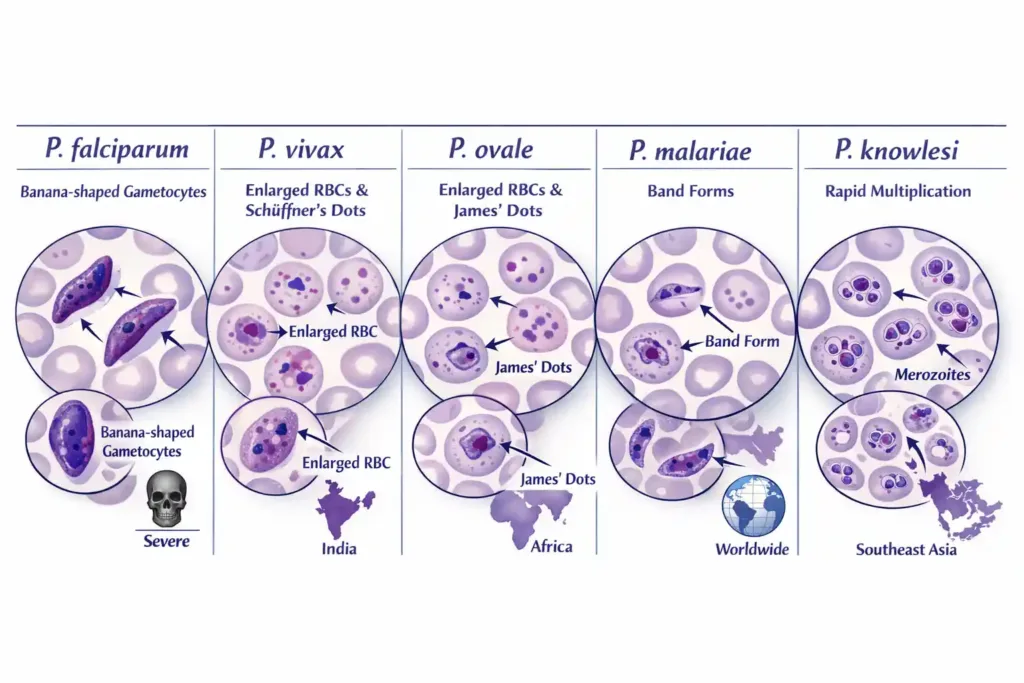
As we read earlier, malaria is caused by parasites of the Plasmodium genus. These are single-celled organisms that fall into the protozoa category. These parasites require two hosts to survive – the mosquito (definitive host) and the human (intermediate host).
Every species has its own characteristics. P. falciparum is the most dangerous because it makes red blood cells sticky, it causes red blood cells to become adhesive, leading them to stick to the walls of blood vessels. P. vivax prefers young RBCs, while P. malariae infects mature RBCs.
Mode of Transmission (Method of Spreading)
Primary Mode – Mosquito Bite:
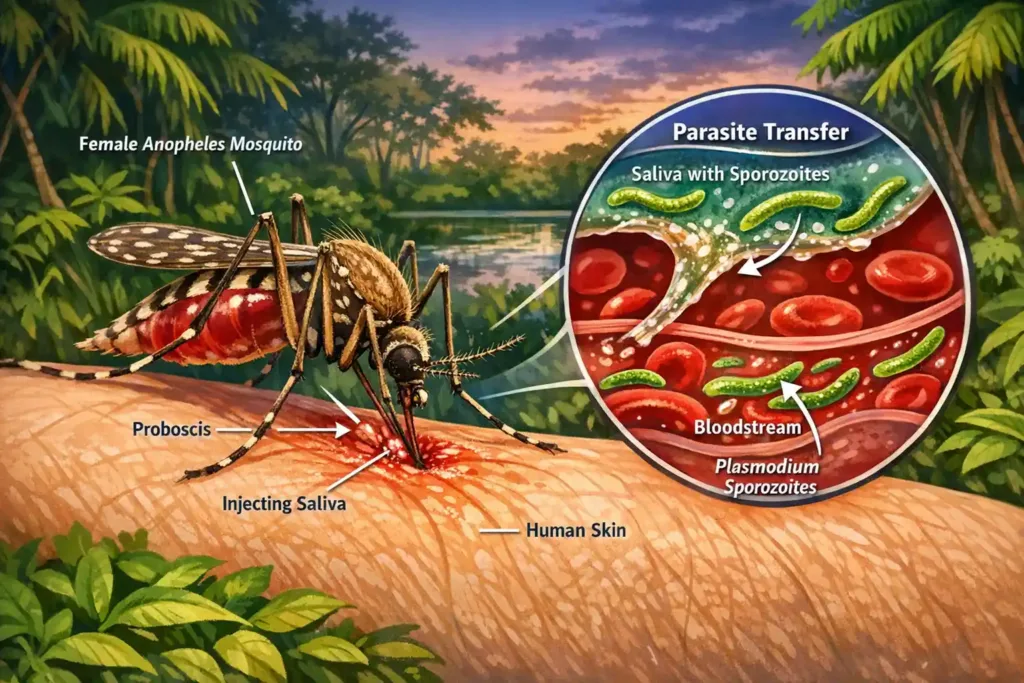
The main transmission of malaria occurs through the bite of the female Anopheles mosquito.
It is important to note that only the female mosquito sucks blood because it needs blood proteins to develop its eggs.
When an infected mosquito bites a healthy person, sporozoites (a form of the parasite) enter the human body with the mosquito’s saliva. This process happens in a few seconds.
The Anopheles mosquito is generally more active in the evening and at night. It breeds in stagnant water, which is why malaria cases increase during the rainy season.
Other Transmission Routes:
Besides mosquito bites, there are a few other ways, although these are rare:
- Blood Transfusion: Malaria can be transmitted if the blood of an infected person is transfused to someone else. This is why blood banks perform proper screening.
- Congenital Transmission: Malaria can be passed from a pregnant woman to her baby; this is called congenital malaria.
- Needle Sharing: Transmission is also possible among drug users who share needles.
- Organ Transplant: In very rare cases, malaria can also occur through organ transplant.
Life Cycle of Malaria Parasite
Understanding the life cycle of the malaria parasite is a bit complex but very interesting. Let’s understand it in two parts:
A. In the Human Body (Asexual Cycle):
Step 1 – Liver Stage (Exo-erythrocytic Schizogony):
- When an infected mosquito bites,sporozoites enter the bloodstream.
- They reach the liver cells (hepatocytes) within 30 minutes.
- In the liver, they multiply and form merozoites.
- In P. vivax and P. ovale, some parasites remain in a dormant form (hypnozoites) in the liver. These can activate much later and cause a relapse. This is why special drugs are needed to completely cure P. vivax
-
There are no symptoms in the liver stage. This lasts for 1-2 weeks depending on the species.
Step 2 – Blood Stage (Erythrocytic Schizogony):
- Merozoites are released from the liver and infect red blood cells (RBCs).Inside the RBC, the parasite multiplies and more merozoites are formed.
- When the RBC bursts, these new merozoites come out and infect other RBCs.
- This cycle keeps repeating, and symptoms start in this stage. Toxins are released when the RBCs burst, which cause fever and chills.
Recent Articles

You won’t be fooled again after seeing this
News If a Woman Has Small Breasts, Does It Really Mean Anything About Her Personality or Body? Experts Break Down Common Myths, Social Stereotypes, Biological Facts, and Misconceptions, Revealing Why Body Features Do Not Define Character, Confidence, Health, or Worth, Challenging Outdated Beliefs and Encouraging a More Realistic, Respectful Understanding of Natural Human Diversity and individual differences
Massive python with swollen belly found under family’s shed — X-ray reveals its last meal

THE FIRST ANIMAL YOU NOTICE MAY REVEAL SOMETHING SURPRISING ABOUT YOUR THINKING STYLE

